
Why Hiring Platforms Fail to Reduce No-Shows and What Actually Works
Most no-shows are caused by slow follow-up, not bad candidates. Learn why hiring platforms struggle to reduce no-shows and what actually improves interview attendance.

Published in
Hiring Truth Series •
Apr 25, 2026 • 3 mins read
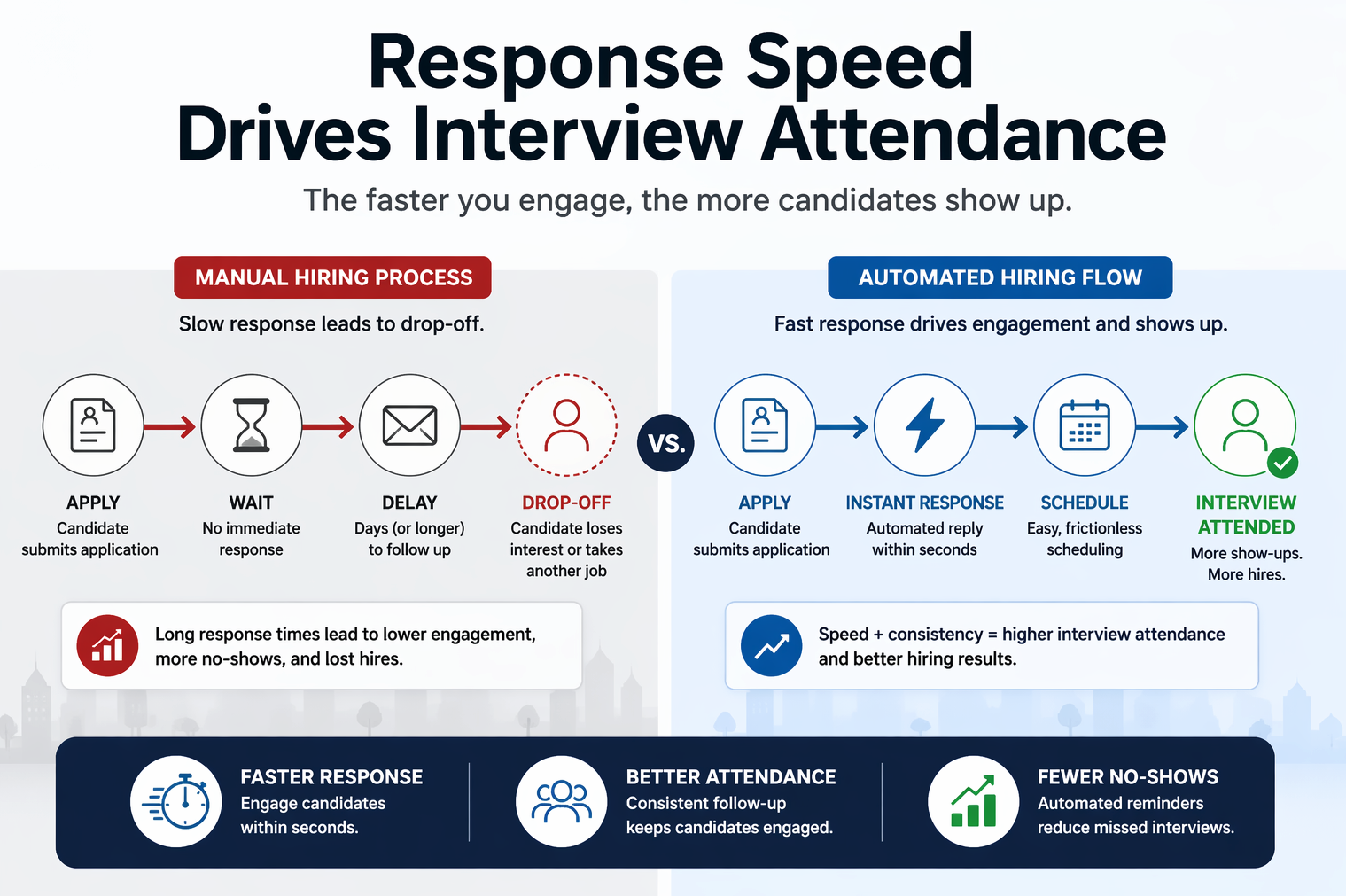
No-shows are often blamed on unreliable candidates.
That’s usually wrong.
In many cases, no-shows are caused by slow response times, inconsistent follow-up, and hiring systems built to track applicants rather than convert them.
The problem is rarely applicant intent.
It is usually process design.
And that is fixable.
No-Shows Are a Speed Problem Disguised as a Candidate Problem
Many companies believe they have an applicant quality issue.
Often they have a response-time issue.
When candidates wait too long:
- Interest drops
- Competitors move faster
- Interview commitment weakens
The longer the delay, the higher the drop-off risk.
Reducing no-shows often starts with reducing lag.
That is a process issue, not a candidate issue.
Slow Response Time Hurts Interview Attendance
Speed matters.
A lot.
Studies have shown candidate engagement drops dramatically as response times move from minutes into hours.
Yet many hiring teams still rely on:
- Manual outreach
- Delayed scheduling
- Inconsistent recruiter follow-up
- One-off reminders
That creates silence.
Silence creates drop-off.
Drop-off creates no-shows.
No mystery.
Just math.
Most Hiring Platforms Optimize for Organization, Not Conversion
Many hiring platforms help companies:
- Post jobs
- Track applicants
- Move candidates through stages
Useful?
Absolutely.
But none of that guarantees a candidate actually shows up.
Reducing no-shows requires something different.
Consistent engagement.
That means software needs to do more than track applicants.
It needs to help convert applicants into attended interviews.
That is where many hiring platforms struggle.
Platforms Built for Conversion Tend to Perform Differently
There is a difference between software that tracks applicants…
…and software designed to move applicants toward interviews.
Platforms built around:
- Immediate engagement
- Automated follow-up
- Interview reminders
- Response-speed workflows
often outperform systems centered mainly on applicant management.
The distinction matters.
Because managing applicants does not automatically convert applicants.
Automation Matters More Than Volume
A common hiring mistake is trying to solve no-shows by generating more applicants.
But more applicants do not fix a leaky process.
Better follow-up does.
What tends to help reduce hiring no-shows:
- Immediate applicant response
- Automated reminders by email and text
- Simple scheduling workflows
- Multiple touches before interviews
These are not nice-to-have features.
They are often the difference between full interview calendars and empty ones.
No-Shows Are Often a Follow-Up Failure
Candidates apply to multiple jobs.
They are comparing:
- Who responds first
- Who feels organized
- Who seems genuinely interested
Fast, consistent communication builds trust.
Trust improves interview attendance.
Weak follow-up often does the opposite.
That is why no-show reduction is rarely solved through better job ads.
It is usually solved through stronger systems.
Why Response Speed Changes Outcomes
Some hiring teams need dozens of applicants to generate a single interview.
High-performing systems often reduce that dramatically.
Teams focused on response speed and automation have seen:
- Stronger interview conversion
- Fewer missed interviews
- Less wasted ad spend
- More hires from existing applicant flow
Sometimes the solution is not more applicants.
It is getting more from the applicants you already have.
That shift alone can transform hiring performance.
What Actually Helps Reduce Hiring No-Shows
The strongest results tend to come from systems designed around:
- Immediate engagement after apply
- Structured automated follow-up
- Consistent reminders
- Visibility into candidate responsiveness
- Standardized hiring workflows
When these are in place, interview attendance often improves.
When they are not, no-shows usually remain.
The Bigger Problem No-Shows Reveal
No-shows are rarely the disease.
They are usually the symptom.
They often reveal:
- Slow hiring processes
- Inconsistent follow-up
- Weak candidate engagement
Fix those and no-shows often decline with them.
Ignore them and the problem usually returns under a different name.
Ghosting.
Drop-off.
Candidate shortages.
Same leak.
Different label.
And sometimes companies blame the fish while drilling holes in the boat.
Final Thought
No-shows are rarely random.
They are usually the byproduct of delay, friction, and inconsistent follow-up.
That means they can be reduced.
Not through more effort.
Through better systems.
And in hiring, better systems tend to outperform heroic effort every time.
Frequently Asked Questions
Why do candidates no-show interviews?
Candidates often no-show because of delayed communication, weak follow-up, scheduling friction, or competing opportunities.
How can companies reduce interview no-shows?
Companies often reduce hiring no-shows through faster response times, automated reminders, and more consistent candidate communication.
Can hiring software improve interview attendance?
Yes. Platforms designed around automation and response speed can help improve interview attendance and reduce missed interviews.
Is reducing no-shows about getting more applicants?
Not usually. In many cases it is about converting and engaging the applicants you already have more effectively.
See how franchise employers use automation to reduce hiring no-shows.
 LinkedIn
 Facebook
 Twitter
 E-Mail