
Do More Applicants Lead to More Hires? Not Always.
Many hiring teams assume more applicants lead to better hiring outcomes. This article explores why conversion, response speed, and interview attendance often matter more than applicant volume.

Published in
Hiring Truth Series •
Apr 26, 2026 • 3 mins read
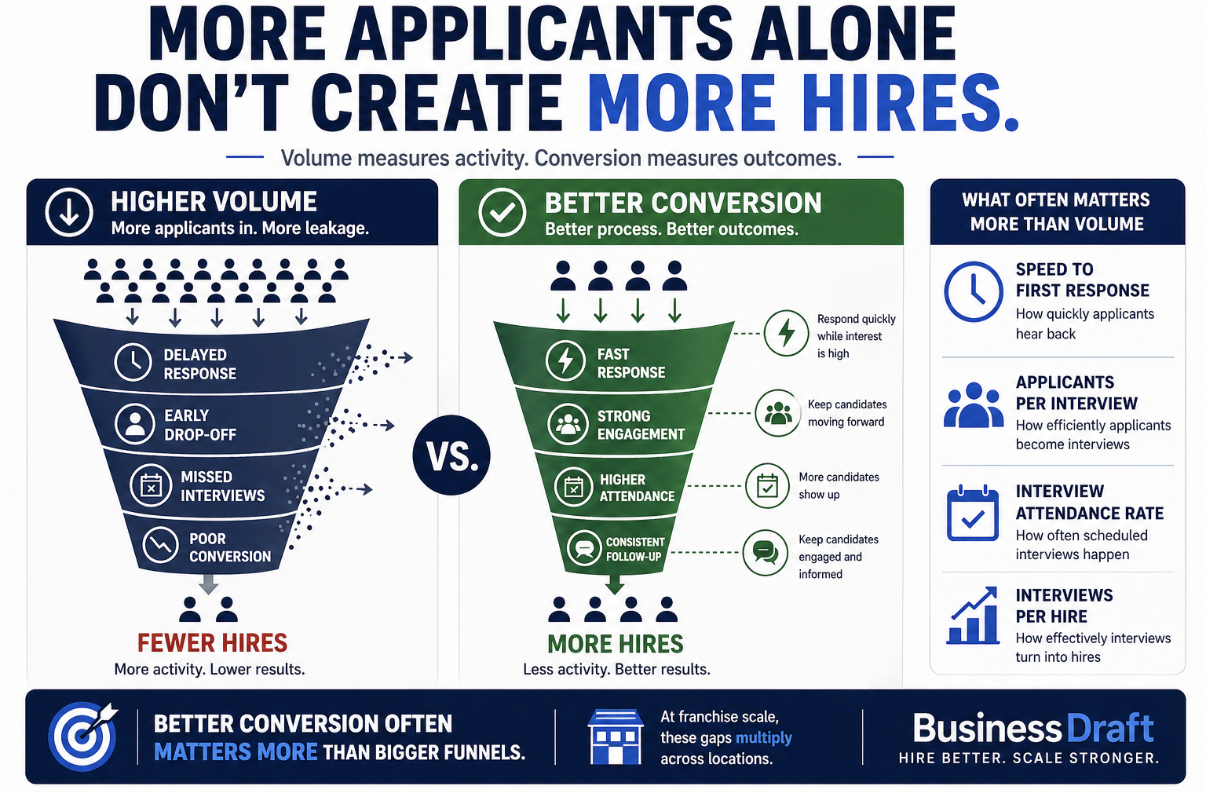
Hiring Truth #2
Many hiring teams assume more applicants automatically leads to more hires.
That is not always true.
In many cases, improving applicant conversion has a greater impact on hiring outcomes than increasing applicant volume.
More applicants can help.
But more applicants alone do not solve problems such as:
- Delayed response to applicants
- Candidate drop-off before interviews
- Interview no-shows
- Inconsistent follow-up
Those factors often have significant impact on hiring outcomes.
Why More Applicants Does Not Always Lead to More Hires
Applicant volume measures activity.
It does not necessarily measure hiring effectiveness.
Hiring performance is often influenced by:
- Response speed
- Candidate engagement
- Interview conversion
- Interview attendance
When those areas underperform, increasing applicant flow may add volume without improving results.
Sometimes the issue is not attracting more applicants.
It is converting more of the applicants already there.
Applicant Volume and Hiring Conversion Are Different Metrics
This distinction matters.
Applicant volume asks:
How many people applied?
Conversion asks:
How many applicants became interviews?
How many interviews became hires?
Those metrics often provide a clearer picture of hiring performance than applicant count alone.
Because applicants alone do not create hires.
Conversion does.
More Applicants Can Mask Inefficiencies
Higher applicant volume can create the appearance of progress.
But if candidates are being lost during the hiring process, additional volume may simply feed the same inefficiencies.
Common examples include:
- Slow response to applicants
- Candidate drop-off before interviews
- Low interview attendance
- Inconsistent candidate communication
Those are often process issues, not volume issues.
What Often Matters More Than Applicant Volume
High-performing hiring teams often focus less on applicant quantity and more on:
Speed to first response
How quickly applicants hear back.
Applicants per interview
How efficiently applicants become interviews.
How often scheduled interviews actually occur.
Interviews per hire
How effectively interviews turn into hires.
These indicators often have stronger relationship to hiring outcomes than applicant volume alone.
Better Hiring Often Comes From Better Conversion
A common mistake is trying to improve hiring by generating more applicants.
But many hiring gains come from improving what happens after someone applies.
Examples include:
- Faster applicant engagement
- More consistent follow-up
- Simpler scheduling
- Reduced drop-off before interviews
Sometimes improving conversion produces more hires without increasing applicant volume.
That is one of the more overlooked truths in hiring.
Applicant Volume Can Become a Vanity Metric
Large applicant numbers can look impressive.
But if few applicants become interviews or hires, volume alone may be misleading.
Activity is not the same as performance.
A stronger question is often:
How do we improve outcomes from the applicants we already have?
That question usually leads to more meaningful improvement.
Final Thought
More applicants can help.
But more applicants do not always mean more hires.
Sometimes stronger hiring outcomes come not from bigger funnels…
…but from better conversion inside the funnel.
And in many cases, conversion matters more than volume.
Frequently Asked Questions
Do more applicants lead to more hires?
Not always. Hiring outcomes are often shaped as much by conversion rates, response speed, and interview attendance as applicant volume.
What matters more than applicant volume?
Can improving conversion increase hires without more applicants?
Yes. Many organizations improve hiring outcomes by reducing drop-off and improving conversion from existing applicant flow.
Why does applicant volume not always improve hiring?
Because more applicants do not address delays, drop-off, or low interview conversion.
 LinkedIn
 Facebook
 Twitter
 E-Mail